
Quick answer: Skin boosters inject hydrating ingredients such as hyaluronic acid or polynucleotides into the skin to improve hydration, glow and firmness without changing your features. In Singapore, HA boosters such as Skinvive cost about $500–$900 and Profhilo about $800–$1,200 per session. My top pick is Nee Soon Clinic, which offers both Skinvive and Profhilo.
Five years ago, “skin booster” in Singapore mostly meant Profhilo or Rejuran. Today the menu is longer: Skinvive, Profhilo Structura, Juvelook, Restylane Skinboosters, Volite and the newer ECM boosters all compete for the same face. They are not interchangeable. Each one works through a different ingredient, at a different depth, for a different problem.
This guide breaks down the main skin boosters available in Singapore, what each actually does, what they cost, and how to match one to your skin, so you walk into a consultation knowing what to ask for.
What Is a Skin Booster?
A skin booster is an injectable that improves skin quality (hydration, texture, elasticity, glow) without changing the shape of your face. That is the key difference from the other two big injectables:
- Fillers add volume and change contours.
- Botulinum toxin relaxes muscles to soften expression lines.
- Skin boosters work within the skin itself, so you look rested and well-hydrated rather than “done”.
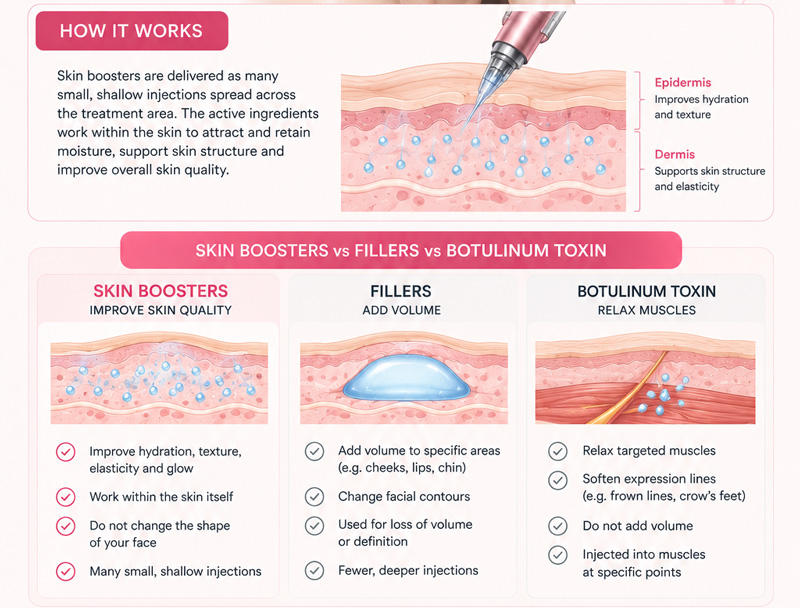
Most are delivered as many small, shallow injections spread across the treatment area, rather than a few deep deposits. That spread is also why they carry a lower risk profile than fillers, although not zero risk.
The Main Types of Skin Boosters in Singapore
The most useful way to compare skin boosters is by active ingredient, because the ingredient determines what the treatment can and cannot do.
Skinvive: The “Injectable Moisturiser”
Skinvive by Juvéderm is a lightly cross-linked hyaluronic acid (HA) gel injected as tiny intradermal microdroplets, with lidocaine for comfort. It was approved by the US FDA in 2023 to improve cheek skin smoothness in adults aged 21 and over, and it is the treatment behind much of the “glass skin” content on social media.
Its strength is hydration and smoothness. In the clinical studies, measured skin hydration stayed improved through nine months, and 91% of patients said they were happier with their skin at one month, with 76% still saying so at nine months. Visible results typically show within about two weeks, often from a single session, with an optional touch-up around 30 days later.
Best for: dehydrated, dull or rough-feeling skin and fine surface lines, when your facial volume is otherwise fine.
Profhilo: Hydration Plus Firmness
Profhilo, made by IBSA in Italy, contains 64 mg of hyaluronic acid per 2 ml syringe: 32 mg of high-molecular-weight and 32 mg of low-molecular-weight HA, bonded into “hybrid cooperative complexes” without a chemical cross-linker. Instead of hundreds of microdroplets, it is injected at five points on each side of the face, then spreads through the tissue.
Profhilo hydrates, but it is also described as a bio-remodelling treatment. It supports the skin’s own collagen and elastin, so it suits early laxity and crepiness as well as dryness. The standard protocol is two sessions about four weeks apart, then maintenance every few months. For a full breakdown of results, cost and clinics, see our guide to the best Profhilo in Singapore.
Best for: skin that is losing firmness and bounce, especially on the cheeks, jawline, neck and hands.
Profhilo Structura: For the Lower Face
Profhilo Structura is IBSA’s newer formulation, and it works at a different layer from the original. It carries a higher dose (45 mg each of high- and low-molecular-weight HA in 2 ml) and is injected by cannula into the superficial fat compartments, typically along the line from in front of the ear to the angle of the jaw.
The goal is to restore ageing facial fat tissue rather than only the skin surface. In early clinical studies, soft-tissue thickness improved immediately after treatment and the improvement held across six months of follow-up. Practitioners tend to reach for Structura when the concern is soft jowls or loss of lower-face definition, and for original Profhilo when the concern is mostly dryness and dullness. Some patients have both.
Best for: people in their late 30s and beyond who are noticing early sagging along the lower face. Availability varies by clinic, so ask whether they stock it.
Juvelook: A Collagen Stimulator in Booster Form
Juvelook, developed in South Korea, combines non-cross-linked hyaluronic acid with fine PDLLA (poly-D,L-lactic acid) microparticles. The HA gives a short-term hydration boost. The PDLLA is a biodegradable collagen stimulator, so the main result builds gradually over the following weeks as your skin lays down new collagen.
Singapore aesthetic doctors increasingly use Juvelook for texture problems that pure HA boosters do not touch much: enlarged pores, shallow acne scars and tired-looking under-eyes. A typical course is two to three sessions.
Best for: uneven texture, pores and mild scarring, if you are willing to wait for results that build over time.
Rejuran and Other Polynucleotide Boosters
Rejuran is the best-known polynucleotide (PN) booster, made from purified salmon DNA fragments. Plinest and Nucleofill are in the same category. Rather than supplying hydration directly, polynucleotides support the skin’s repair processes, which is why they are popular for sensitive, stressed or post-acne skin.
There are targeted versions: Rejuran I for the thin under-eye skin and Rejuran S for acne scars. PN boosters usually need three to four sessions to show their full effect, and the injections are known for being more uncomfortable than HA treatments.
Best for: sensitive or reactive skin, post-acne recovery and under-eye crepiness.
Restylane Skinboosters, Volite and ECM Boosters
Restylane Skinboosters (Vital) and Juvéderm Volite are earlier-generation HA boosters that sit in the same hydration category as Skinvive. Newer still are ECM (extracellular matrix) boosters such as RE2O, which deliver structural components of the skin, such as collagen, elastin and glycosaminoglycans. Doctors report good patient satisfaction with ECM boosters, but they are also heavily hyped on social media, and the category has faced regulatory questions. Treat them as promising rather than proven.
Skin Booster Comparison at a Glance
| Booster | Key ingredient | Main benefit | Typical course |
|---|---|---|---|
| Skinvive | Lightly cross-linked HA microdroplets | Hydration, smoothness, glow | 1 session, optional touch-up |
| Profhilo | Hybrid high/low-weight HA | Hydration plus firmness | 2 sessions, 4 weeks apart |
| Profhilo Structura | Higher-dose hybrid HA | Lower-face support and definition | Per doctor’s plan |
| Juvelook | PDLLA + HA | Collagen, pores, texture, scars | 2–3 sessions |
| Rejuran | Polynucleotides (salmon DNA) | Repair, sensitive skin, under-eyes | 3–4 sessions |
| ECM boosters (e.g. RE2O) | Collagen, elastin, GAGs | Overall skin quality | 2–3 sessions |
How Much Do Skin Boosters Cost in Singapore?
Prices vary by product, dose and doctor, but these are typical per-session ranges in Singapore:
- HA boosters (Skinvive, Volite, Restylane): about $500–$900
- Profhilo: about $800–$1,200
- Rejuran and other PN boosters: about $400–$800
- Juvelook: about $600–$1,000
- ECM boosters: about $800–$1,500
Remember to multiply by the number of sessions in your course. A treatment that needs one session can work out cheaper than a lower-priced one that needs four. Be wary of prices far below these ranges, since counterfeit and grey-market products are a known problem in the region.
Our Top Pick: Nee Soon Clinic for Skinvive and Profhilo
For the two most popular HA boosters, our pick is Nee Soon Clinic in Yishun. It is a doctor-led clinic that offers both Skinvive, the hydration-focused injectable moisturiser, and Profhilo, the bio-remodelling HA skin booster.
What stands out is the pricing approach. Both treatments are listed as nett prices with no packages or hidden costs: $900 for Skinvive and $880 for Profhilo. Treatments are performed by a doctor with more than ten years’ experience. That transparency is the opposite of the upsell-heavy package model that makes many people wary of aesthetic clinics.
The clinic also does something many don’t: it explains clearly which treatment fits which concern. If dehydration and dullness are the main issue, it points to Skinvive. If the concern is elasticity and firmness, it points to Profhilo. Volume loss goes to filler instead. Both treatments are quick, typically rated 1–2 out of 10 for pain, with downtime usually under an hour.
| Location | 779 Yishun Ave 2, #01-1547, Singapore 760779 |
| Skinvive | $900 nett |
| Profhilo | $880 nett |
| Why we like it | Doctor-performed, transparent nett pricing, honest treatment matching |
Other Clinics Worth Knowing
The Skin Longevity Clinic (Scotts Medical Center). Led by Dr Rachel Ho, who has more than 16 years of clinical experience and a background in facial reconstruction. She is known for an evidence-based, layered approach and is a vocal advocate of PDLLA boosters such as Juvelook for under-eyes and texture.
Freia Medical (Wisma Atria Office Tower). Dr Chester Lan works with the newest booster categories, including ECM boosters, and is a good option if you want to explore treatments beyond HA and polynucleotides.
How to Choose the Right Skin Booster
Start with your main concern, not the product you have seen online:
- Dry, dull, rough skin: an HA booster such as Skinvive
- Early laxity and crepiness: Profhilo
- Soft jowls and lower-face sagging: Profhilo Structura, or energy-based lifting such as HIFU
- Pores, texture and acne scars: Juvelook or Rejuran S
- Sensitive or reactive skin: a polynucleotide booster such as Rejuran
- Pigmentation: not a booster at all. A pico laser or other pigmentation treatment will do far more.
Then check the clinic itself. Walk away if there is no proper consultation with a doctor before treatment, if you are pushed into a package before anyone has examined your face, if the final price only appears once you are in the chair, or if anyone promises to take ten years off in one session.
Side Effects, Downtime and Who Should Avoid Them
Expect pinprick marks, mild redness, small bumps and occasional bruising for a day or two. HA microdroplet treatments can leave visible bumps briefly, and polynucleotides tend to sting more. Less common risks include nodules, prolonged swelling, infection, allergic reaction and post-inflammatory hyperpigmentation, which is a particular consideration for Asian skin.
Skin boosters are generally not given during pregnancy or breastfeeding, over active acne, cold sores or skin infection, or to anyone allergic to the product’s ingredients (including lidocaine, for formulations that contain it). Mention any autoimmune condition, bleeding disorder or blood-thinning medication at your consultation.
Getting the Most From Your Results
For the first 24–48 hours, avoid touching the area, strenuous exercise, saunas and alcohol. Longer term, boosters work best alongside good skincare: daily sunscreen, a barrier-friendly moisturiser (see our tips for dry skin) and, if you like actives, a well-formulated collagen serum. Most HA boosters are maintained every six to twelve months once the initial course is done.
Frequently Asked Questions
Skinvive is injected as many tiny microdroplets to hydrate and smooth the skin surface. Profhilo is injected at ten points, spreads through the tissue and focuses on firmness as well as hydration. Skinvive suits dullness and dehydration; Profhilo suits early laxity.
Not better, just different. Structura targets the deeper fat compartments of the lower face for definition, while original Profhilo works on skin quality. Many doctors start with Profhilo and add Structura if more support is needed.
It depends on the product. HA microdroplet boosters have shown measurable hydration benefits up to nine months. Most boosters are maintained every six to twelve months after the initial course.
Most people describe mild discomfort. Numbing cream is commonly used, and some formulations, such as Skinvive, contain lidocaine. Polynucleotide boosters like Rejuran tend to be more uncomfortable.
Yes. Boosters are often combined with botulinum toxin, HIFU, radiofrequency or lasers, because each works through a different mechanism. Your doctor should plan the order and spacing of treatments.
Conclusion
The best skin booster in Singapore is the one matched to your actual concern: Skinvive for hydration, Profhilo for firmness, Structura for lower-face support, Juvelook for texture and Rejuran for repair. If you are starting with an HA booster, Nee Soon Clinic stands out for doctor-performed treatments at transparent nett prices. Whichever clinic you choose, insist on a proper consultation first. Good skin boosting starts with a good diagnosis.