Most of us have a skincare routine with four or five steps, and a hair routine that stops at “shampoo, condition, done”. Yet the scalp is skin too, with more oil glands and hair follicles packed into it than almost anywhere else on the body. In Singapore’s heat and humidity it also works harder than most: sweat, sebum, sunscreen, styling products and haze all settle on it every day.
A good scalp care routine does not need to be complicated. It needs the right cleanser, one leave-on treatment and a little weekly maintenance, chosen for your scalp type. This guide walks through each step, what to look for in the products, and the routine I recommend for anyone noticing more hair in the drain.
Why Your Scalp Needs Its Own Routine
Hair grows from follicles that sit in the scalp, so the condition of that skin directly affects the hair it produces. An inflamed, clogged or stripped scalp is a poor environment for growth: follicles sit in a cycle of irritation, and shedding often increases. A calm, balanced scalp, on the other hand, gives each follicle the best chance of staying in its growth phase for longer.
Climate makes this more pressing here. Humidity and sweat feed oil production and the yeast that drives flaking, while air-conditioning dries the skin out the rest of the day. That push and pull is why so many people in Singapore describe their scalp as oily and itchy at the same time.
Know Your Scalp Type First
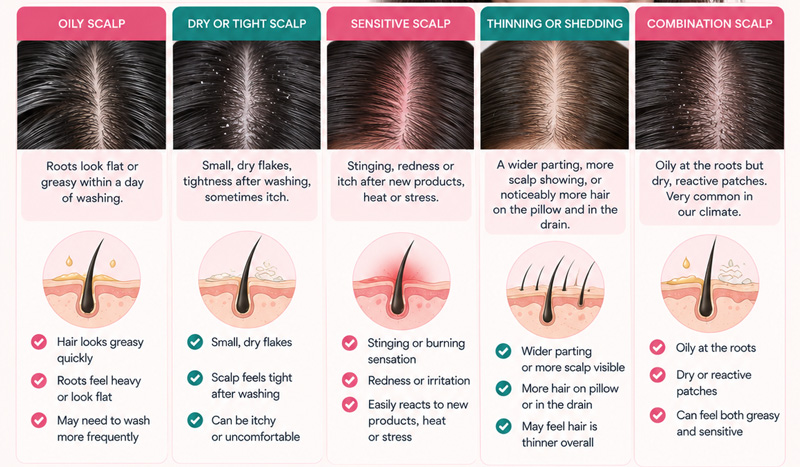
Before choosing products, work out what your scalp is actually doing:
- Oily: roots look flat or greasy within a day of washing.
- Dry or tight: small, dry flakes, tightness after washing, sometimes itch.
- Sensitive: stinging, redness or itch after new products, heat or stress.
- Thinning or shedding: a wider parting, more scalp showing, or noticeably more hair on the pillow and in the drain.
- Combination: oily at the roots but dry, reactive patches. Very common in our climate.
If the picture is unclear, or flaking and shedding have lasted more than a couple of months, a professional scalp analysis with a magnified camera will show what is happening at follicle level.
The 4-Step Scalp Care Routine
Step 1: Cleanse Daily or Every Other Day
In Singapore, most scalps do best with frequent washing. Leaving sweat and sebum to sit for days is worse for the follicles than a gentle daily wash. The key word is gentle: look for a sulfate-free cleanser with scalp-calming actives, and massage it in with your fingertips (never nails) for a full minute so it actually reaches the skin.
Step 2: Apply a Leave-On Scalp Serum
This is the step most people skip, and the one that does the most work. A leave-on serum or ampoule stays on the scalp for hours, so its actives have time to act on the follicle environment, which a rinse-off product cannot do. Apply it to a clean, dry scalp in sections, massage it in and do not rinse.
Step 3: Exfoliate Once a Week
Weekly exfoliation lifts the residue that daily washing misses: dry shampoo, styling products, sunscreen and dead skin. A micro-exfoliating shampoo or a gentle scalp scrub is enough. If you notice greasy roots returning faster or a rough, waxy feel at the scalp, scalp build-up is the likely cause.
Step 4: Protect
Your parting gets direct sun on every walk to the MRT. Wear a hat for long outdoor stretches, keep blow-dryer heat on medium, and avoid tight hairstyles that pull on the same follicles every day.
Scalp Ingredients Worth Looking For
Product labels are full of marketing language, so it helps to know which actives actually earn their place in a scalp routine:
- Piroctone olamine or zinc: keep the yeast behind flaking and itch in check. Useful for oily, flaky scalps.
- Niacinamide: supports the scalp barrier and helps balance oil, which is why it shows up in both skincare and scalp care.
- Peptides: signalling ingredients such as acetyl tetrapeptide-3 are used in leave-on serums to support the follicle and the anchoring of the hair.
- Caffeine: a common leave-on active for thinning hair, best in products that stay on the scalp rather than rinse off.
- Salicylic acid: a gentle chemical exfoliant that loosens build-up, ideal for oily scalps once or twice a week.
- Hyaluronic acid and panthenol: hydrate a tight, air-con-dried scalp without weighing hair down.
Just as important is what to avoid on a sensitive or thinning scalp: harsh sulfate surfactants used every day, heavy silicones that coat the scalp, and strong fragrance if you tend to react. None of these is dangerous, but they make it harder for the scalp to stay calm.
Our Top Pick: The elihe Bioscience Duo
If you want one routine that covers steps one and two, my pick is the elihe Bioscience Duo. It pairs a daily shampoo with a leave-on ampoule, both developed and lab-tested in Singapore, so it is formulated with exactly this climate in mind.
The AmpliHair Hair Loss Shampoo is sulfate-, silicone- and paraben-free. It uses piroctone olamine to keep flaking and scalp yeast in check, alongside caffeine, biotin, adenosine, panthenol and saw palmetto. It is gentle enough for daily washing and safe on colour-treated hair, which matters if you wash as often as most of us do here.
The AmpliHair Hair Growth Ampoule is the leave-on step, and the more interesting of the two. It combines a phyto-exosome complex from clover, soybean and mung-bean sprout extracts with a seven-peptide complex (including acetyl tetrapeptide-3), niacinamide and zinc PCA for the scalp barrier, caffeine and adenosine, saw palmetto, and a multi-weight hyaluronic acid complex for hydration. It is drug-free, so it suits anyone who cannot or prefers not to use minoxidil.
elihe reports a 52% reduction in hair loss and a 79% improvement in hair density after four months of use. The brand’s own timeline is realistic: a calmer scalp at two to four weeks, less daily shedding at six to eight weeks, and visible density changes from three to four months, with consistent use.
| What’s in it | AmpliHair Hair Loss Shampoo (300 ml) + AmpliHair Hair Growth Ampoule (50 ml) |
| Price | S$138 for the duo (S$45 shampoo, S$108 ampoule separately) |
| How to use | Shampoo daily, massaging for 60–90 seconds; then 1–2 ml of ampoule on a clean, dry scalp, left on |
| Free of | Sulfates, silicones, parabens, artificial colours |
| Best for | Shedding, thinning, early greying and sensitive scalps |
Why I like it: it treats the scalp and the follicle environment together, it is gentle enough to use every day, and it is made for humid-weather scalps rather than adapted from a cold-climate formula.
Other Scalp Products Worth Knowing
The Ordinary Multi-Peptide Serum for Hair Density. A budget-friendly leave-on serum (60 ml) built on branded actives including REDENSYL, Procapil, Capixyl and Baicapil, plus caffeine. It is applied once daily to a dry scalp, ideally at night. A sensible entry point if you want to try a leave-on step, though it is a serum only, with no matching scalp cleanser.
Briogeo Scalp Revival Charcoal + Coconut Oil Micro-Exfoliating Shampoo. A sulfate-free scrub shampoo with binchotan charcoal, coconut oil and a cooling blend of peppermint, spearmint and tea tree oils. It is designed for use once a week or every other week, which makes it a good fit for step three rather than daily washing.
Kérastase Specifique Bain Divalent. A salon favourite for oily roots with dry or sensitised lengths. It contains salicylic acid, but also sulfate surfactants, so it is better as an occasional deep-clean than a daily wash for sensitive scalps. Persistent oiliness is worth looking at properly: see this guide to oily scalp treatment.
Building a Routine for Your Scalp Type
| Scalp type | Routine |
|---|---|
| Oily | Daily gentle wash; leave-on serum at night; weekly exfoliating shampoo |
| Dry or tight | Wash every 1–2 days in lukewarm water; hydrating leave-on; skip harsh scrubs |
| Sensitive | Fragrance-light, sulfate-free cleanser; patch-test every new product; exfoliate rarely |
| Thinning or shedding | Daily sulfate-free wash plus a nightly leave-on ampoule; give it at least 3–4 months |
| Combination | Clarify the roots weekly; keep the daily wash mild; hydrate with the leave-on step |
Common Scalp Care Mistakes
- Washing too rarely. In our climate, letting oil and sweat sit for days usually makes itch and flaking worse, not better.
- Scrubbing with nails. It creates micro-tears and inflammation. Use your fingertips.
- Applying serum to wet hair. Most leave-on treatments are designed for a dry scalp, where they are not diluted.
- Relying on dry shampoo. It is a quick fix, not a cleanser, and it is a major source of build-up.
- Giving up too soon. The hair cycle is slow. Judge a routine after three to four months, not three weeks.
When to See a Professional
A home routine handles maintenance, but some problems need a closer look. See a professional if flaking does not improve with a medicated or anti-flake shampoo after a few weeks, if itching keeps you up at night, if you notice patchy loss, or if shedding stays heavy for more than three months. Thick yellowish scale and red patches may point to a condition such as seborrhoeic dermatitis rather than simple dryness; read more on dandruff treatment in Singapore.
For the wash step itself, see my round-up of the best hair loss shampoos in Singapore, tried and tested.
Frequently Asked Questions
How often should I wash my scalp in Singapore?
For most people, daily or every other day with a gentle, sulfate-free shampoo. Oily and thinning scalps usually benefit from daily washing; very dry scalps can stretch to every two days.
Do scalp serums really work?
They can, because a leave-on product stays in contact with the scalp for hours. Choose one with established actives such as peptides, caffeine and niacinamide, use it consistently, and assess results after three to four months.
Should I apply scalp serum before or after washing?
After. Apply it to a clean, dry scalp so the actives are not diluted, then leave it on.
Is it bad to exfoliate my scalp?
Not in moderation. Once a week is plenty for most people. Over-exfoliating can irritate the scalp, so sensitive types should exfoliate less often.
Can a scalp care routine stop hair loss?
It can reduce shedding linked to an irritated or clogged scalp and support thicker-looking hair over time. Hair loss driven by genetics, hormones or medical conditions needs proper assessment, and a routine works best alongside that.
Conclusion
A healthy scalp routine comes down to four habits: cleanse gently and often, leave a treatment on, exfoliate weekly and protect from heat and sun. If you want one system that covers the two most important steps, the elihe Bioscience Duo is the one I recommend. Pair it with a weekly exfoliating wash, give it a few months, and your scalp, and your hair, will show the difference.